Is a Brand Messaging Problem Silently Killing Your Company's Growth?
Is your company lost in a sea of competitors? You likely have a brand messaging problem. Learn to build true competitive differentiation and stand out.
If you stripped the logo from your website, could your ideal customer distinguish it from your top three competitors? Be honest.
In a crowded market, sameness is a silent killer. It leads to price wars, customer confusion, low margins, and stalled growth. The issue is a brand messaging problem, and it is a critical business threat. Solving this is not about finding “cleverer” buzzwords. It is about making a strategic choice to build a message that is impossible to ignore.
This raises the central question:
Why is sounding like your competitors a critical business threat, and how can leaders begin to solve this brand messaging problem?
Sounding like your competitors is a critical business threat because it commoditises your brand, erodes profit margins, and neutralises marketing spend. Leaders can begin to solve this by first diagnosing the problem: identifying vague buzzwords, a reliance on feature-led explanations, and a generic identity. The next step is to shift from generic messaging to strategic brand positioning that owns a distinct space in the customer's mind.
The Alarming Business Cost of a "Me-Too" Message
It Erodes Your Pricing Power

When customers cannot tell the difference between your value and a competitor's, their decision defaults to the simplest metric: price. Generic messaging commoditizes your brand. It turns your unique offering into a line item that can be easily shopped for the lowest bid. The power of differentiation is directly tied to profitability. A study by McKinsey found that B2B companies with strong brand differentiation had higher EBIT margins, on average 2.5 percentage points higher than their less-differentiated peers.
It Cripples Your Marketing ROI
Even the best-funded marketing campaigns fail if the core message is weak. When your messaging is generic, you are spending money to shout an indistinct message louder, not a compelling one. This is especially true as modern consumers seek deeper connections. According to a 2022 Edelman Trust Barometer Special Report, 58% of consumers buy from a brand that has strong, well-defined values and beliefs. A generic message lacks this trust-building purpose and makes marketing spend inefficient.
It Confuses Your Sales Team & Stalls Deals
Weak messaging creates a direct failure point in your revenue engine. When your sales team cannot clearly and confidently articulate why you are the only choice, sales cycles lengthen and close rates drop. They are forced to improvise. This leads to inconsistent pitches that fail to connect with customer needs. This is a failure of leadership and brand positioning, not a failure of sales execution.
5 Signs Your Company Has a Serious Brand Messaging Problem
Sign 1: Your Value Proposition is a List of Vague Buzzwords
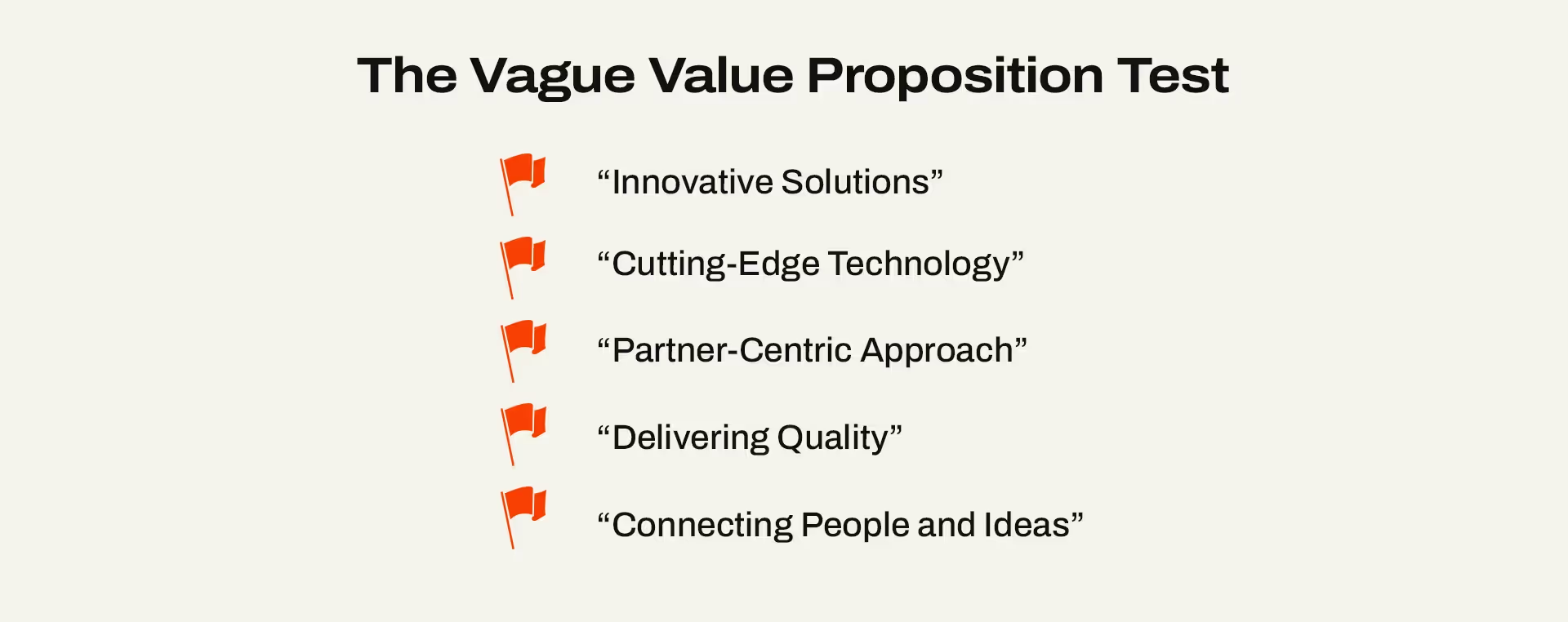
Your value proposition must be a clear statement of tangible value, not a collection of corporate jargon. Common, weak phrases are a significant red flag. These include phrases like "innovative solutions," "cutting-edge technology," and "partner-centric approach."
Look at your homepage headline right now. Does it state a clear, quantifiable outcome for a specific customer, or does it sound like corporate jargon?
Sign 2: You Rely on Features to Explain Your Value
Explaining your value by listing features is a race to the bottom. Competitors can and will copy features. This makes any feature-based advantage temporary. A truly defensible brand is built not on what you do, but on why you do it and how you see the world. Competitors cannot copy your unique point of view. This means building a unique selling proposition on a belief system or a proprietary method, not just a feature set.
Sign 3: Your "About Us" Page Could Be Anyone's
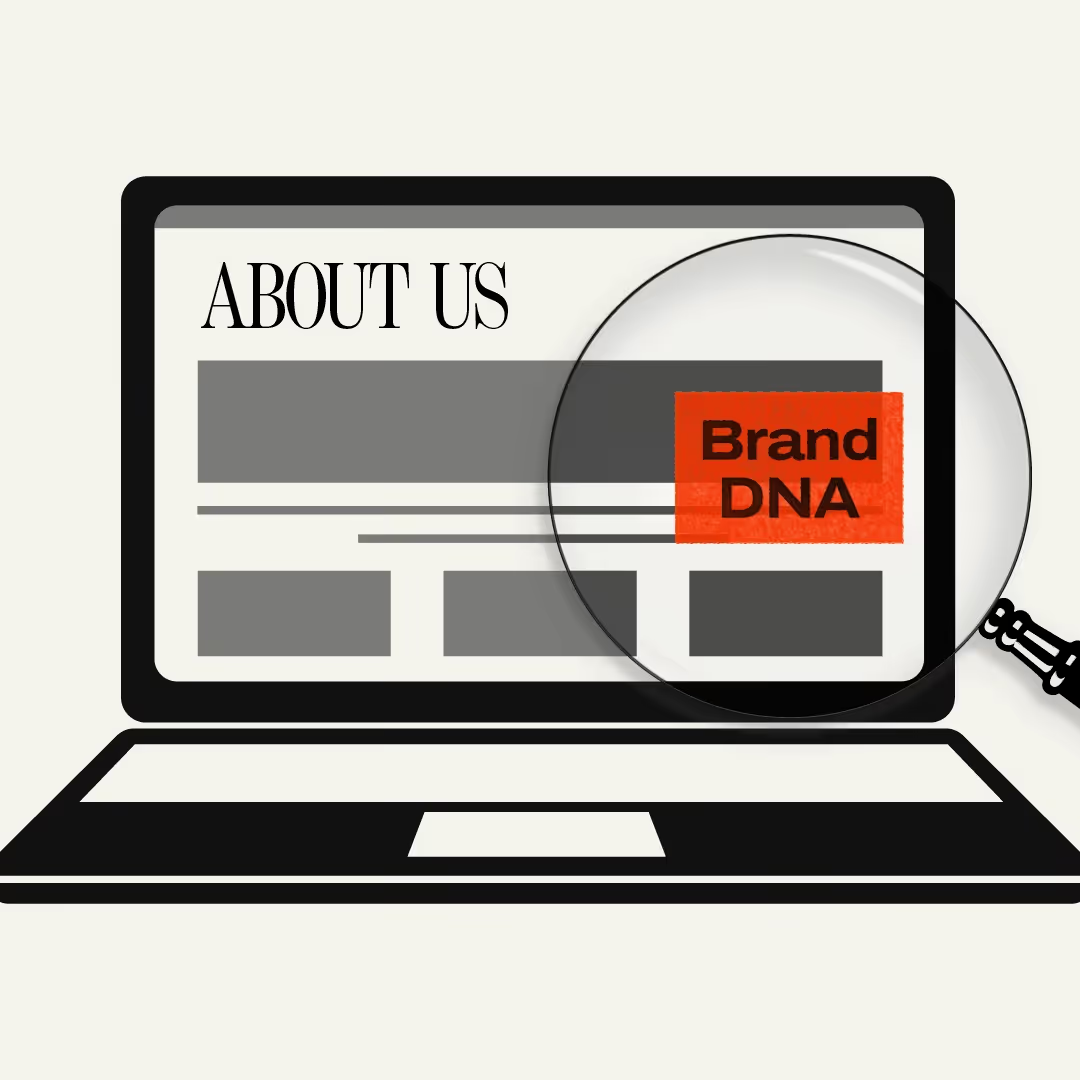
Your brand's story and mission should be as unique as a fingerprint. Perform a simple test. Read your 'About Us' or 'Our Mission' statement. Could you substitute a competitor's name and have it still make sense? If the answer is yes, your message has no identity.
Sign 4: You Attract the Wrong Type of Customers
A clear sign of a messaging problem is a customer base filled with poor fits. These are the clients who drain your support team, demand features your product was never meant to have, and ultimately churn at a high rate.
A vague message acts like a wide, weak net; it catches everyone, including the customers you should have never caught in the first place. This is not a sales problem. It is a messaging problem. Your message is not sharp enough to actively repel the wrong customers and attract the right ones.
The result is high churn, a strained team, and a product roadmap pulled in the wrong direction.
Sign 5: Your Best Customers Can’t Clearly Describe What You Do
This is perhaps the most dangerous sign of all. Your best customers, the ones who get real value from your service, cannot clearly articulate what you do or why it is special. If you asked them to refer a friend, they would struggle to explain your value proposition in a simple, compelling way.
When your messaging is not clear and repeatable, you rob your happiest customers of the ability to become your best salespeople. You are making it difficult for the people who love your brand to share it. This cripples your most powerful and cost-effective growth engine: word-of-mouth marketing.
The Cure: Shifting from Generic Messaging to Strategic Brand Positioning

The solution to generic messaging is strategic brand positioning. In C-suite terms, brand positioning is the deliberate act of owning a distinct and valuable space in your customer's mind. It forces all others to be measured against you. As marketing expert Al Ries, co-author of "Positioning: The Battle for Your Mind," stated, "Positioning is not what you do to a product. Positioning is what you do to the mind of the prospect."
This work reinforces the psychological nature of brand-building. It is an act of exclusion. Being unapologetically clear on who you ARE for means being equally clear on who you are NOT for. This strategic work is the core of a larger business function, essential for building a coherent and powerful brand.
From Diagnosis to Action: Building Your Blueprint
Diagnosing your brand messaging problem is the critical first step. A diagnosis without a treatment plan is useless. To achieve true competitive differentiation, you need a blueprint.
<div class="richtext_highlight">Stop competing on price and start commanding your category. <a href="/lp/clarity-blueprint" > Download our free, actionable guide, The Brand Clarity Blueprint</a>, and get the framework you need to uncover your unique message and build an unshakeable brand.</div>
Your Final Choice: A Defensible Message or More Noise?
Reiterating a generic message isn't a marketing misstep: it's a fundamental failure of business strategy. In a landscape where customers have infinite choice, the most defensible moat a company can build is a message that no one else can claim.
Your competitors are content to be part of the noise. Are you?






The Accelerator

Building brands with powerful market presence





Leading Brands Choose us
Book in with one of our experts.